Flatten a Multilevel Doubly Linked List
LeetCode July - Day 10
Problem Statement
You are given a doubly linked list which in addition to the next and previous pointers, it could have a child pointer, which may or may not point to a separate doubly linked list. These child lists may have one or more children of their own, and so on, to produce a multilevel data structure, as shown in the example below.
Flatten the list so that all the nodes appear in a single-level, doubly linked list. You are given the head of the first level of the list.
Example 1:
Input: head = [1,2,3,4,5,6,null,null,null,7,8,9,10,null,null,11,12] Output: [1,2,3,7,8,11,12,9,10,4,5,6] Explanation:
The multilevel linked list in the input is as follows:
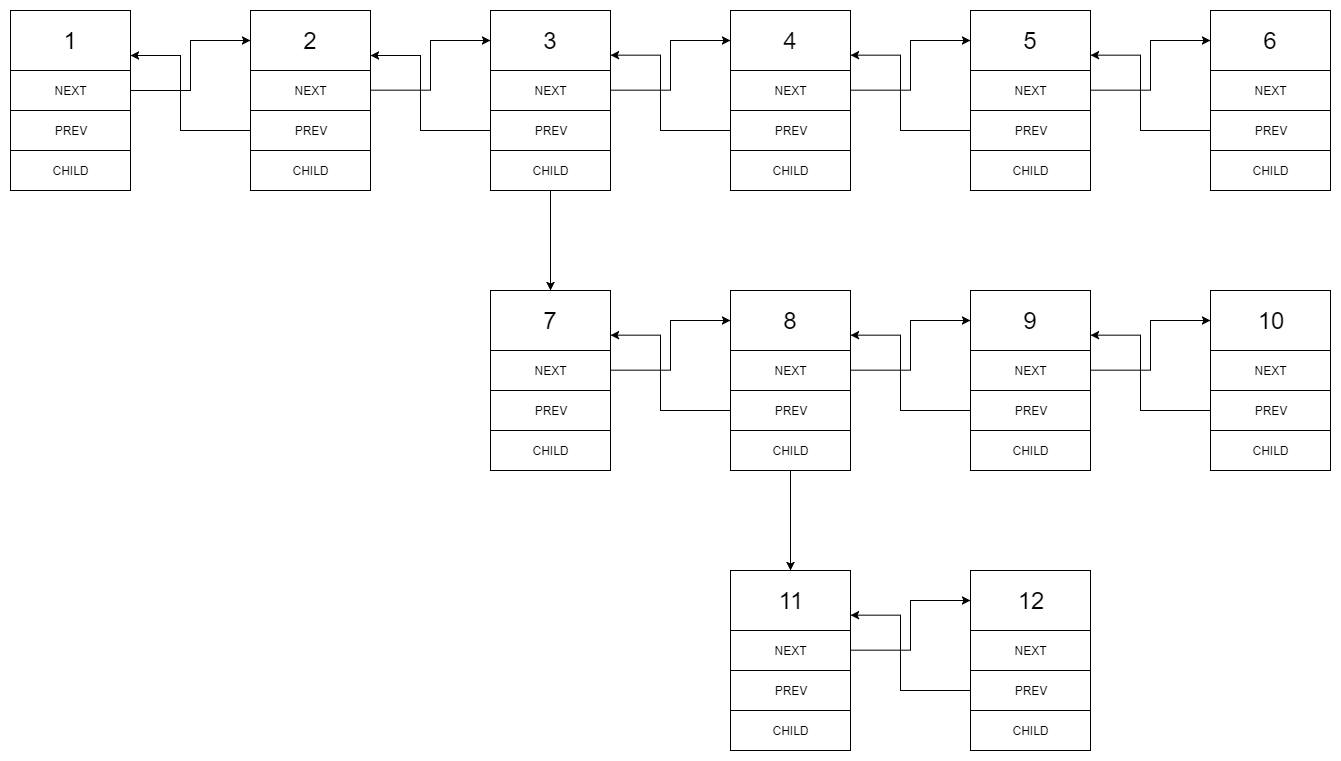
After flattening the multilevel linked list it becomes:

Example 2:
Input: head = [1,2,null,3] Output: [1,3,2] Explanation:
The input multilevel linked list is as follows:
  1---2---NULL
  |
  3---NULL
Example 3:
Input: head = [] Output: []
How multilevel linked list is represented in test case:
We use the multilevel linked list from Example 1 above:
 1---2---3---4---5---6--NULL
         |
         7---8---9---10--NULL
             |
             11--12--NULL
The serialization of each level is as follows:
[1,2,3,4,5,6,null]
[7,8,9,10,null]
[11,12,null]
To serialize all levels together we will add nulls in each level to signify no node connects to the upper node of the previous level. The serialization becomes:
[1,2,3,4,5,6,null]
[null,null,7,8,9,10,null]
[null,11,12,null]
Merging the serialization of each level and removing trailing nulls we obtain:
[1,2,3,4,5,6,null,null,null,7,8,9,10,null,null,11,12]
Constraints:
Number of Nodes will not exceed 1000. 1 <= Node.val <= 10^5
Inputs, Outputs, Constraints & Exceptions
- I: Node
- O: Node
- C: none, optimise
- E: head is null, only on node in list, every node (except parent) is a child
Code
/**
 * // Definition for a Node.
 * function Node(val,prev,next,child) {
 *    this.val = val;
 *    this.prev = prev;
 *    this.next = next;
 *    this.child = child;
 * };
 */
/**
 * @param {Node} head
 * @return {Node}
 */
const flatten = (head) => {
    if(!head){return null} //error

    const q = []
    q.push(head)
    let curr = null, prev = null;

    while(q.length){
      curr = q.pop()
      while(curr){
        if(curr.child){
          q.push(curr.next)
          curr.child.prev = curr
          curr.next = curr.child
          curr.child = null
        }

        prev = curr
        curr = curr.next
      }

      let lastNode = q[q.length - 1]
      if(lastNode){
        prev.next = lastNode
        lastNode.prev = prev
      }
    }
    return head
}
Time complexity: O(N)
- where N is the number of nodes in the list
Space complexity: O(N)
- worst case where every parent node has a child and next node